Robust and Efficient Fine-tuning of LLMs with Bayesian Reparameterization of Low-Rank Adaptation
TMLR 2025
Abstract
MonteCLoRA is a Bayesian variant of LoRA for parameter-efficient fine-tuning of LLMs. It models low-rank adapters as mixtures of Gaussians with Wishart and Dirichlet hyperpriors, and uses Monte Carlo estimation to obtain low-variance, unbiased updates of LoRA parameters. This reduces sensitivity to hyperparameters and stabilizes fine-tuning, improving both robustness and accuracy on NLU and NLG benchmarks with only O(r) extra parameters for rank r.
TL;DR
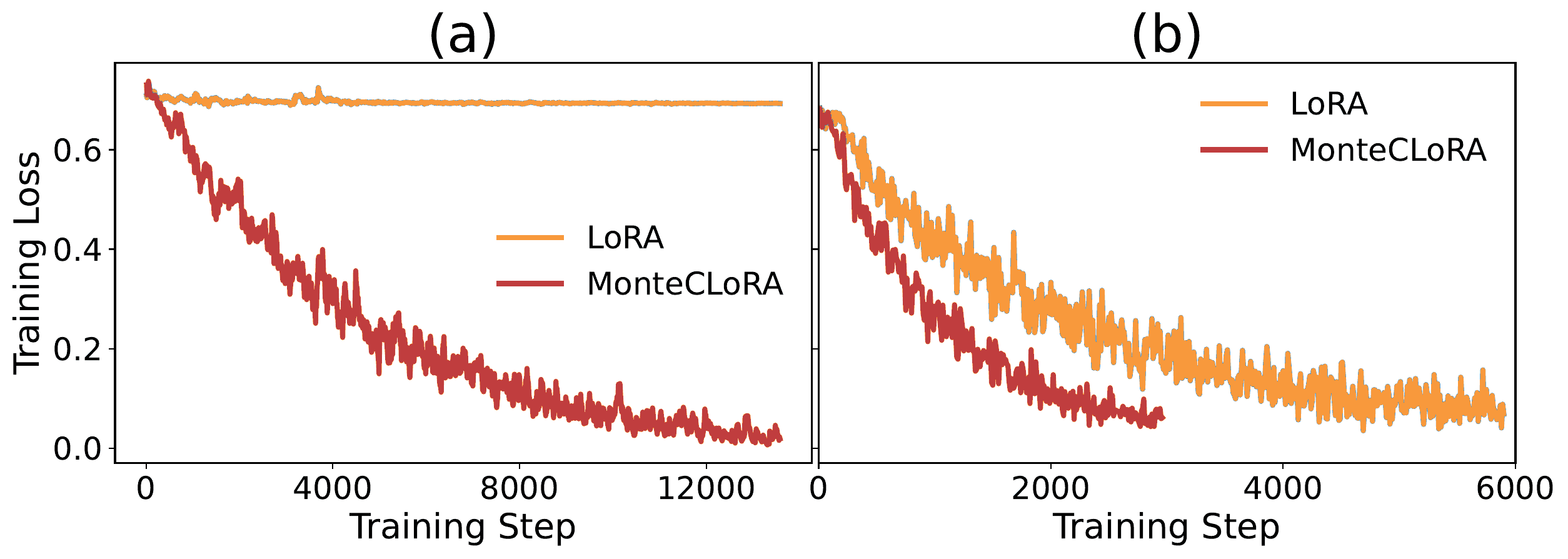
LoRA is lightweight but surprisingly brittle: small hyperparameter changes can swing performance by 10–20 points. MonteCLoRA turns LoRA into a Bayesian, Monte Carlo–estimated adapter, keeping the same mean behavior but smoothing the loss landscape and dramatically improving robustness across learning rates and batch sizes.
Why this research?
LoRA is the go-to PEFT method, but in practice it behaves like a temperamental guest:
- Tiny tweaks in learning rate or batch size can cause large swings in validation accuracy.
- Full fine-tuning is often even less stable and much more expensive.
- Exhaustive hyperparameter sweeps on large LLMs are simply not affordable.
Existing “fixes” (MC Dropout, Laplace-LoRA, ensembles, temperature scaling) are mostly post-hoc calibration tricks: you train a brittle model and then try to bandage its uncertainty.
This paper asks a different question:
Can we make LoRA intrinsically robust by changing how the low-rank update itself is parameterized?
MonteCLoRA in one picture
Classic LoRA learns a deterministic low-rank matrix (A).
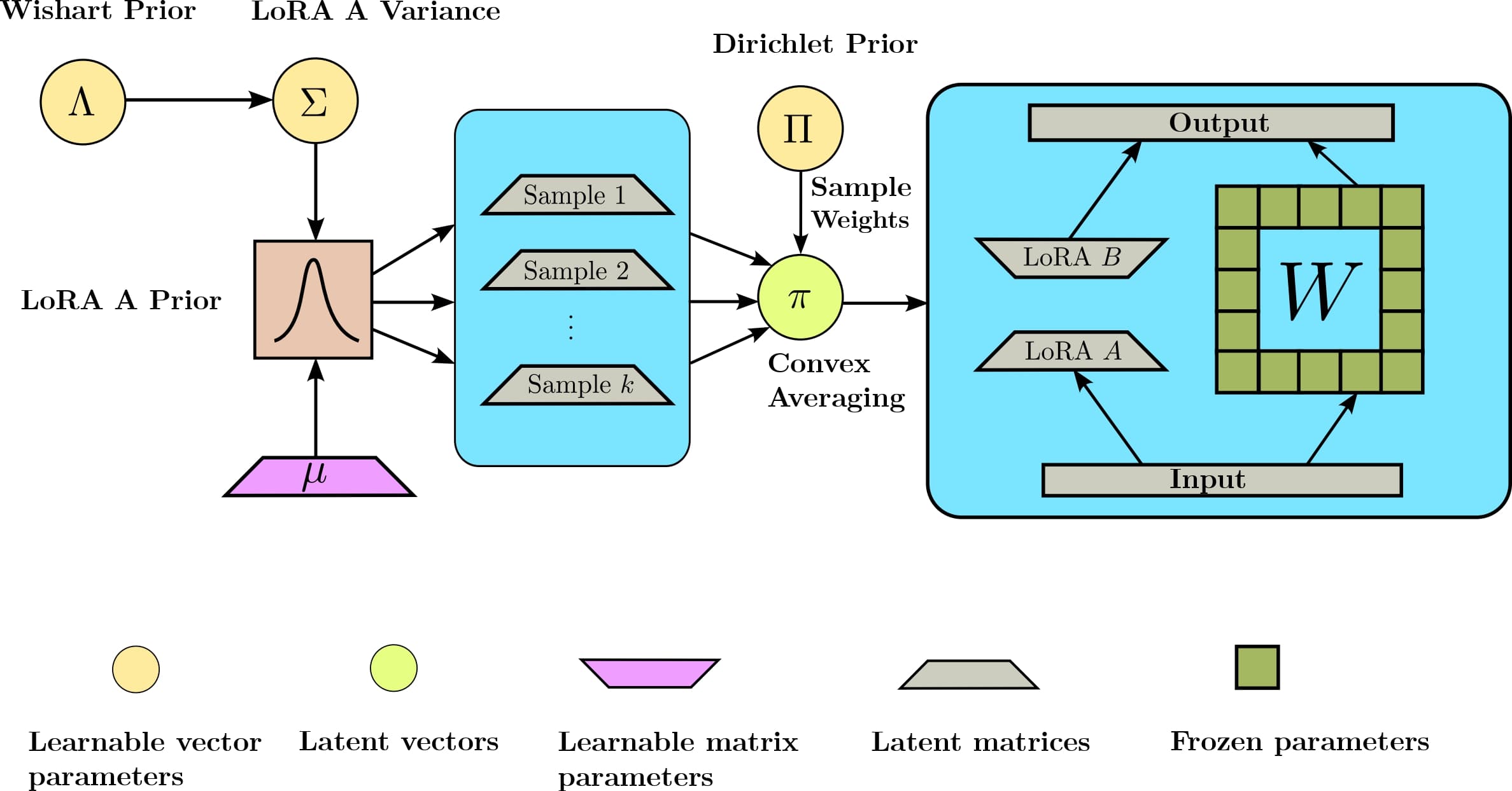
MonteCLoRA replaces each column of (A) with a stochastic mixture of Gaussians:
- Treat each LoRA column as:
- A mean vector plus
- A mixture of Gaussian samples drawn from a shared covariance.
- Mixture weights follow a Dirichlet prior; covariance comes from a Wishart prior.
- Draw (N) samples, combine them with the mixture weights, scale them by a factor (\varepsilon), and add them back to the mean.
This yields a stochastic low-rank update whose expected value is still the original LoRA weight, but whose randomness:
- Regularizes the model,
- Smooths sharp minima,
- And makes the training trajectory much less sensitive to hyperparameters.
Training objective = task loss + KL regularizers:
- KL for the Gaussian (towards a standard normal),
- KL for the Wishart covariance,
- KL for the Dirichlet weights,
- Plus a cooperative loss to keep all mixture components active (avoid collapse).
Overhead is modest: roughly (O(r + N)) extra parameters per LoRA layer ((r) = rank, (N) = mixture components).
Main insights
-
Unbiased but more stable LoRA
The expected adapter equals standard LoRA, but stochastic sampling provides built-in regularization and wider, flatter minima—leading to more stable validation performance across hyperparameters. -
End-to-end Bayesian LoRA, not post-hoc
Unlike MC Dropout or Laplace-LoRA, MonteCLoRA is trained from scratch with its Bayesian structure baked into the optimization, not slapped on afterward. -
Robustness across tasks and models
From RoBERTa on GLUE to LLaMA-7B on commonsense reasoning and LLaMA-3.2-3B on GSM8k / HumanEval, MonteCLoRA consistently:- Matches or improves best-case accuracy,
- Shrinks the spread (worst–best gap) in validation metrics by up to ~50–60%.
-
Better calibration for free
Negative log-likelihood (NLL) and calibration curves improve over LoRA and Bayesian post-hoc methods without extra calibration stages. -
Low extra cost
With buffered sampling and clever implementation, training overhead is on the order of 1.2–1.7× LoRA and memory overhead ≈ 1.06–1.25×, which is far cheaper than large hyperparameter sweeps or ensembles.